
Name-Based Case Searches
Start with the Colorado Judicial Docket Search filtered to Cheyenne County when you mainly want a hearing date. It costs nothing to use. Pick the 15th Judicial District, then Cheyenne County. From there, choose County Court, District Court, or both courts at once. The form needs a date plus at least one other filter. For a person, type a last name. Add a first name if you have it. Businesses go in a separate name field. One caution: what comes back is a list of scheduled matters. It is not the full story of a case.
Names repeat, so a match may not be the case you want. Check the case class, court type, date, and caption before you trust a result. A name that returns nothing is not proof the case is absent. It may simply have no hearing in the date window you chose. Or it may use a different spelling, sit in a municipal or federal court, or be restricted from public view.
- Choose the 15th Judicial District and Cheyenne County.
- Select County Court, District Court, or both, then choose the date range.
- Enter the person's first and last name or the business name as the extra required filter.
- Compare court type, case class, case number, and setting before noting the result.
- Use the Cheyenne County clerk request route when a complete register of actions or filed document is needed.
| Field Label | Type | Required | Cheyenne County Use |
|---|---|---|---|
| Judicial District | Dropdown | Part of location filter | Select 15th Judicial District |
| County | Dropdown | Part of location filter | Select Cheyenne County |
| Court Type | Select | No | Both, County, or District |
| Date Range | Select/date picker | Yes | Choose a preset range or a specific date |
| First and Last Name | Text | Conditional | Used for an individual-party search |
| Business Name | Text | Conditional | Used instead of individual fields |
Cheyenne County Docket Search Filters
The statewide daily docket form offers more than a name box. A Cheyenne County search can narrow by courthouse. It can also filter by division, party, attorney, or pieces of a case number. Attorney mode takes a bar number or a first and last name. Case classes run from C, CR, CV, CW, DR, JD, JV, M, PR, R, S, and T. Those codes matter. They keep a traffic or misdemeanor setting distinct from a district civil hearing. The statewide docket interface presents the same form before it is narrowed to Cheyenne County.
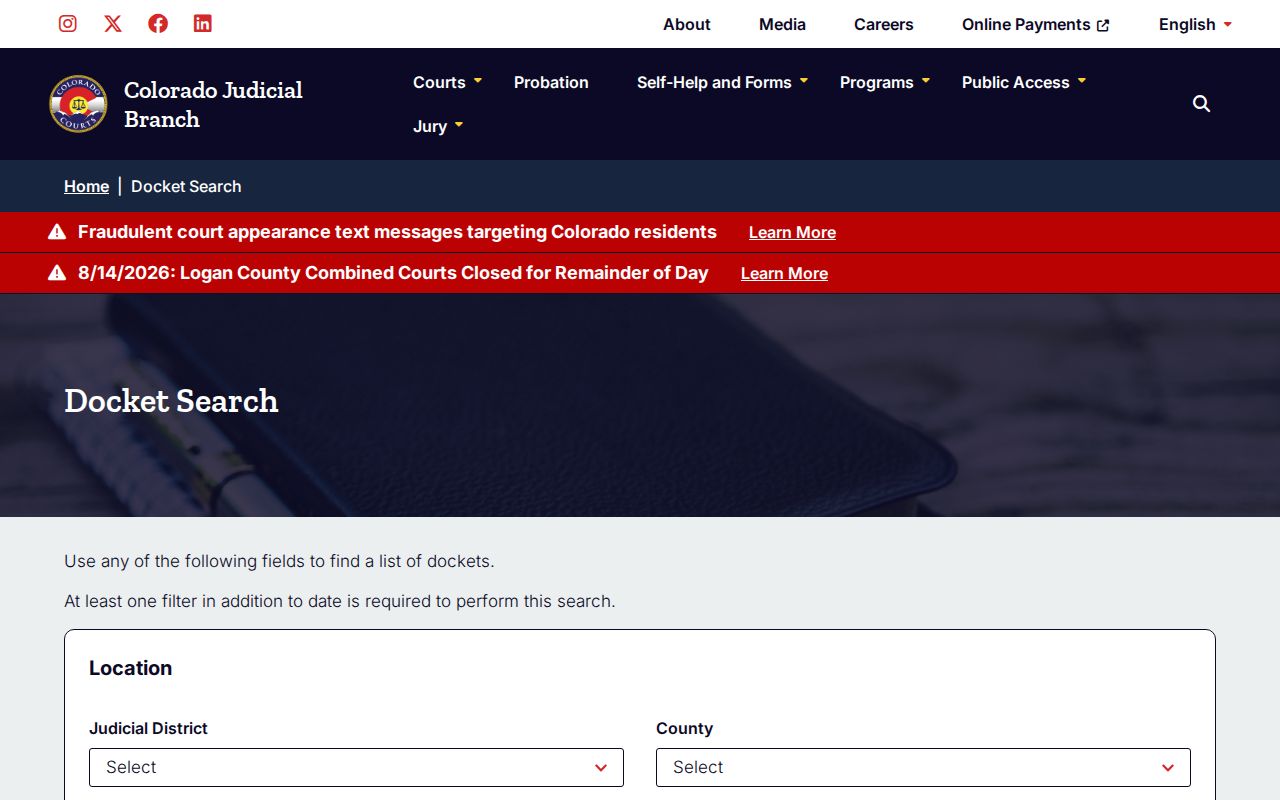
The form image explains why location, date, and one added filter deserve care. Pick the wrong county and you can get a convincing but false no-result search.
Kit Carson is where that warning bites. The Town of Kit Carson sits inside Cheyenne County. Yet Kit Carson County is a separate place entirely. A state-court case from the town must be searched under Cheyenne County. Municipal matters go through the town's own channel.
Note: The free Cheyenne County court docket shifts whenever a setting is reset. So confirm any near-term hearing with the Cheyenne County clerk.
Case Number Searches
A Colorado case number stitches together three parts. There is a four-digit filing year, class letters, and a numeric sequence. The public form splits those pieces into separate boxes. Take 2019T999999 as the official example. The 2019 is the year, T marks the traffic class, and 999999 is the sequence. Other handy classes include CR for district criminal, CV for district civil, and M for county misdemeanor. C stands for county civil, S for small claims, and PR for probate.
A full number is usually the cleanest route. It separates similar names at a stroke. Match every component exactly. Then select Cheyenne County and choose the court type that fits the class. Older documents sometimes format the number with spaces or punctuation. In that case, enter the raw year, class, and sequence in the form's individual boxes. An uncertain number can be resolved by the Cheyenne County Combined Court clerk.
Cheyenne County Case Search Fallback
A reader with only a name can go past the calendar form. Give the statewide document request a few details. Name the party, a likely filing year, the case type, and Cheyenne County. The Cheyenne County clerk may then run the published $5 name search. That should identify the matching case number.
This route shines when no hearing falls inside the chosen window. It also spares you from guessing at a class code. Supply enough detail to separate similar names. But hold back protected information unless the court requests it through an approved channel.
Cheyenne County Case Search Layers
Colorado uses two terms here. It says "docket" for the list of scheduled proceedings. For the chronological case history, it says "register of actions," or ROA. The free Judicial Branch search answers what is set. A paid approved vendor can display the real-time electronic ROA. The Cheyenne County clerk, meanwhile, keeps the official file. These are related products, yet none should be mistaken for another.
The Colorado Judicial court-record search page routes readers to the available record channels.
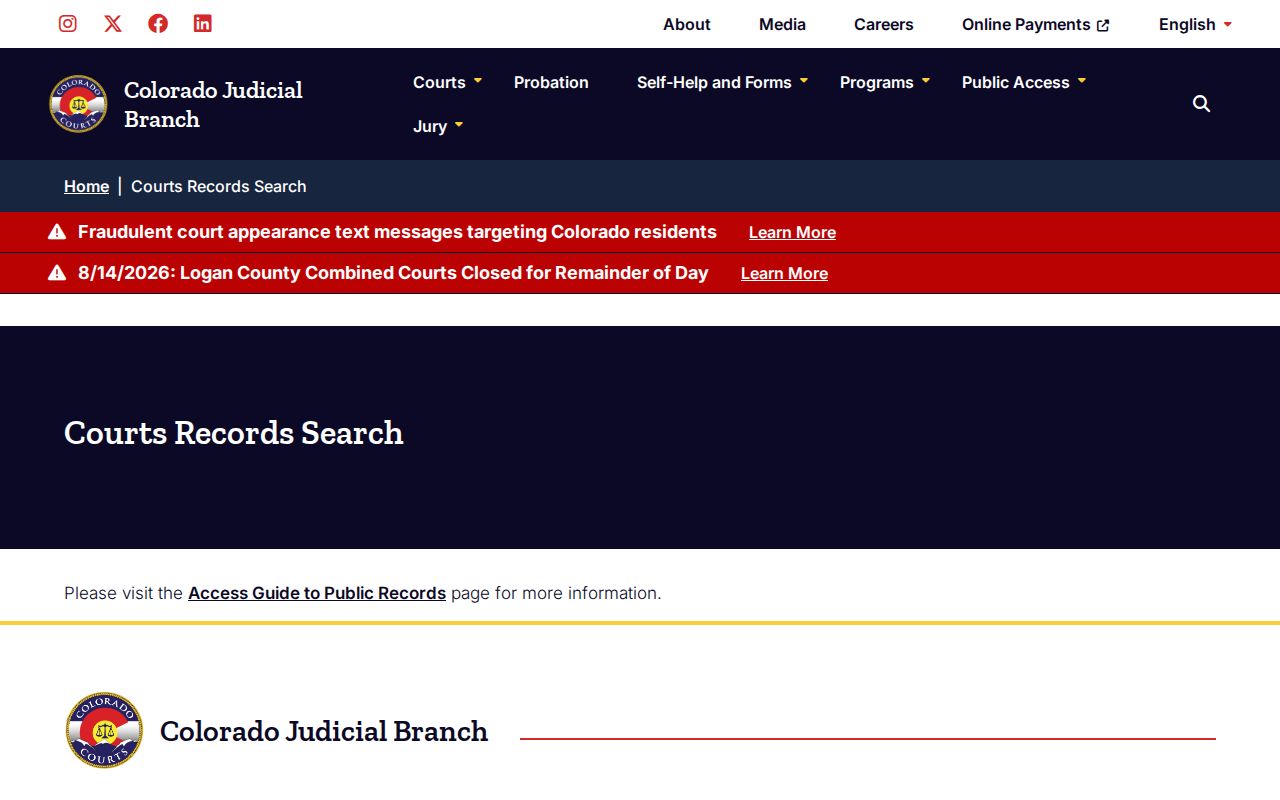
The records page states one key limit plainly: online data is not the official record, and online vendors do not provide copies of filed documents. Plan on the clerk for anything official.
| Search Layer | Best For | Main Limit |
|---|---|---|
| Free Judicial Docket Search | Cheyenne County hearings and court dates | Scheduled proceedings, not full history |
| Approved ROA vendor | Real-time chronological case activity | Fee based, incomplete, uncertified, no filed copies |
| Combined Court clerk | Official ROA, documents, older files, certification | Search, copy, retrieval, or certification fees may apply |
Case Search Results Explained
A calendar result is built around a single setting. It should carry enough context to identify the case and the proceeding. But it promises no complaint, motion, order, or other document image. Results shift with the date and may paginate across pages. There is no export feature.
A fuller ROA opens with the case number, court, division, filing date, status, and caption. It then walks through parties and counsel. After that come filings, minute orders, hearing notices, continuances, disposition, and money entries. The label "filed" means only that the Cheyenne County clerk accepted an item. It does not mean the judge granted the request. Read the later order for the actual ruling.
| Case number | Year, class, and sequence that identify the matter |
|---|---|
| Court and division | County or District Court and the assigned division |
| Setting | Date, time, and proceeding type shown on the daily docket |
| Event history | Chronological filings, minute orders, notices, and outcomes in an ROA |
| Status or disposition | Recorded posture or outcome, which may require the signed order for detail |
Cheyenne County Attorney Case Search
The daily docket also works by attorney. Pick attorney mode. Then enter a Colorado bar number or the lawyer's first and last name alongside the Cheyenne County and date filters. That route helps when a party name is incomplete but counsel is known.
Remember what a hit gives you. An attorney result is calendar data only, not the full register of actions. Check the case number and court type. Then go through the approved register or clerk channel for the filing history.
Cheyenne County Case Search Limits
Colorado Judicial names the commercial sites allowed to sell real-time register-of-actions access. One authorized vendor is LexisNexis CoCourts. Its coverage can span civil, water, small claims, domestic, felony, misdemeanor, and traffic classes. Charges apply. The data flows from the electronic County and District Court database. The Judicial Branch cautions that some cases and case types never show up there.
The authorized CoCourts interface displays the official manifest for the search view.
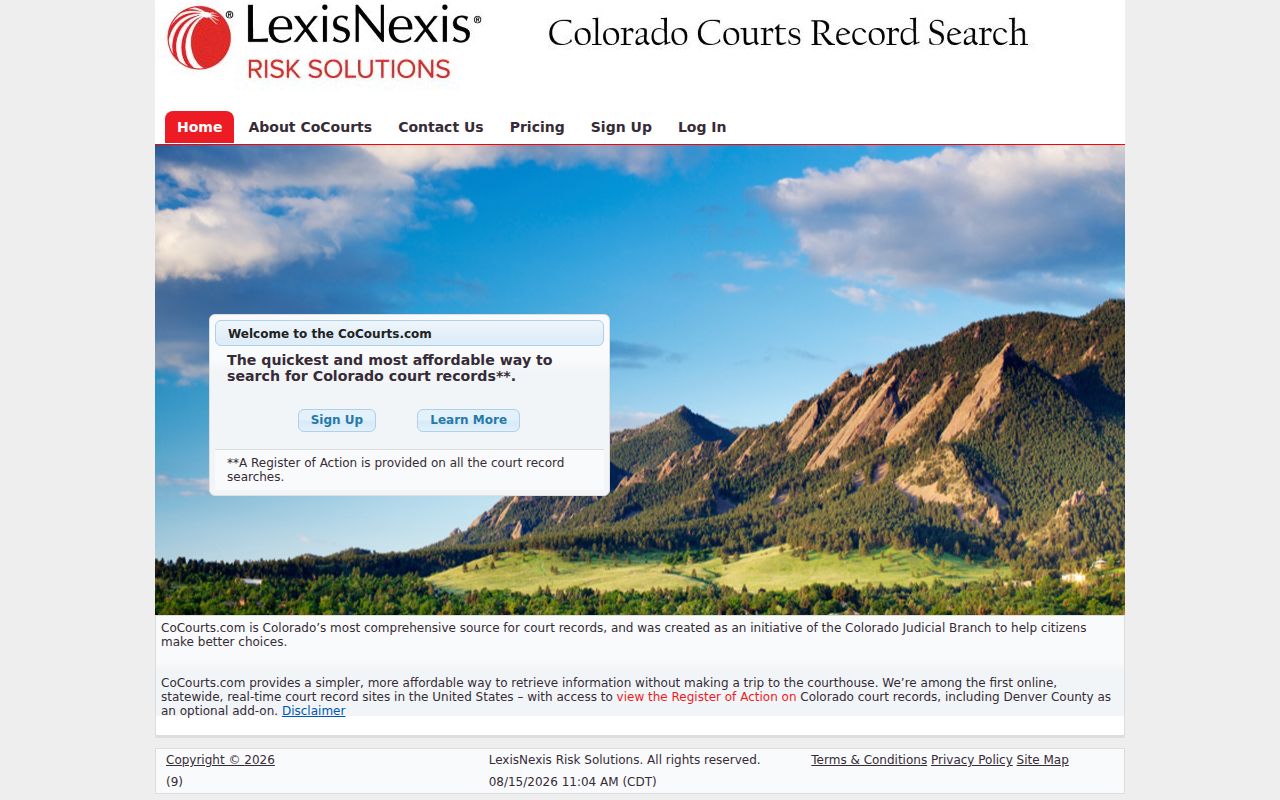
This paid Cheyenne County search can trace case activity. Just remember that "real-time" is not the same as certified or official, so order any filing you need from the Combined Court clerk.
Online stop point: A vendor ROA indexes case activity but does not supply the filed complaint, order, judgment, ticket, or certified copy.
Two Ways to Search: County and State
Cheyenne County runs no separate county-built case-history portal. Its trial courts sit on Colorado's statewide systems, while the local court and clerk hold the county-specific official file. So the real choice is not between two duplicate web databases. It is a statewide online route versus direct access through Cheyenne County Combined Court.
Need an official ROA or a filed document? Submit the statewide Record/Document Request Form and select Cheyenne County. The court usually answers within three business days unless circumstances require more time. You can also request in person, by phone, email, mail, and by fax once the office confirms it accepts that channel. The office is at 51 S. 1st St., P.O. Box 696, Cheyenne Wells, CO 80810. Call 719-767-5649 or email colleen.palmer@judicial.state.co.us. The published fax number is 719-931-0022.
| Route | Use It When | Cheyenne County Detail |
|---|---|---|
| Statewide online search | A scheduled hearing or electronic ROA is enough | Filter to the 15th District and Cheyenne County |
| Online document request | An official ROA or named document is needed | Select Cheyenne as the record location |
| Clerk counter, phone, email, or mail | The case is older, missing, ambiguous, or needs certification | Combined Court handles both County and District files |
| Town or federal court | The initiating paper names a municipal or federal court | Use that custodian, not the state trial-court search |
Cheyenne County Case Search Boundaries
Municipal and federal cases never enter the Cheyenne County state trial-court database. A Cheyenne Wells or Kit Carson ordinance citation stays with the town that filed it. Federal matters arising in the county belong to the U.S. District Court for the District of Colorado. They are searched through PACER.
The paper that started the case tells you where it lives. Read the court name before you change any search fields. Typing a municipal or federal matter into the state docket form will not make it appear.
Missing Cheyenne County Case Searches
No Cheyenne County case showing up? Check the spelling, the filing year, the case class, and the County-versus-District selection. Widen the date range if you are hunting a hearing. Make sure it is not a Cheyenne Wells or Kit Carson municipal matter. Federal cases run through PACER, not Colorado Judicial Docket Search.
Still nothing? Call or email the Combined Court clerk. Ask whether the file is off-site, suppressed, protected, or simply missing from the vendor feed. When the case number is unknown, a $5 name-search fee may apply. The statewide request form also takes party information, filing year, case type, and other identifiers. Older off-site files can carry real retrieval costs.
Use the same fallback whenever the web record and the court paper conflict. The official clerk file controls. Need the filing itself? Move from the docket entry to the Cheyenne County court case records request process.Note: An empty search can mean a narrow date window, a different custodian, or an access limit. It is not proof of dismissal.
Cheyenne County Private Case Searches
Live docket results can carry party names. So use search interfaces without republishing private case details. A person can check a date on their own case. They can follow a matter of public interest or watch local court activity without pasting a named result into some other public record. When you need proof, request the official paper from the clerk. That route preserves the court's redactions, its access checks, and its certification process. A copy of shifting calendar data proves far less.
Which Cases Stay Restricted
Chief Justice Directive 05-01 and the Colorado Supreme Court's public-access rules control state court records. Public portions may be inspected and copied. Sealed records open only to authorized judges, court staff, Judicial Department staff, or someone with lawful authority, so a sealed or suppressed matter may be missing from an ordinary search.
Juvenile access turns on the Children's Code and who is asking. Adoption and protected family content can also be restricted. Some probate, juvenile, suppressed, or protected requests require government-issued photo identification. Even when a file is public, personal identifiers may be redacted.
Restricted access: Clerk staff cannot override a seal or statutory limit. A court order or other legal authority may be required.
A public docket search still helps you follow court activity, check a date, or track your own matter. But it is not the final word on access. When exact status matters, verify with the Cheyenne County clerk who keeps the official file.