
Cheyenne County Court Record Requests
Colorado's statewide Record/Document Request Form is the widest online channel. Cheyenne County is a choice on it. Pick that county as the record location. Enter the case number if you have it. Without one, give party names, the filing year, the case type, and any other identifying facts the clerk can work with. Check "Register of Action/ROA" when you want the chronological index of a Cheyenne County docket. For a specific filing, name it. Or describe it well enough to stand apart from other docket entries.
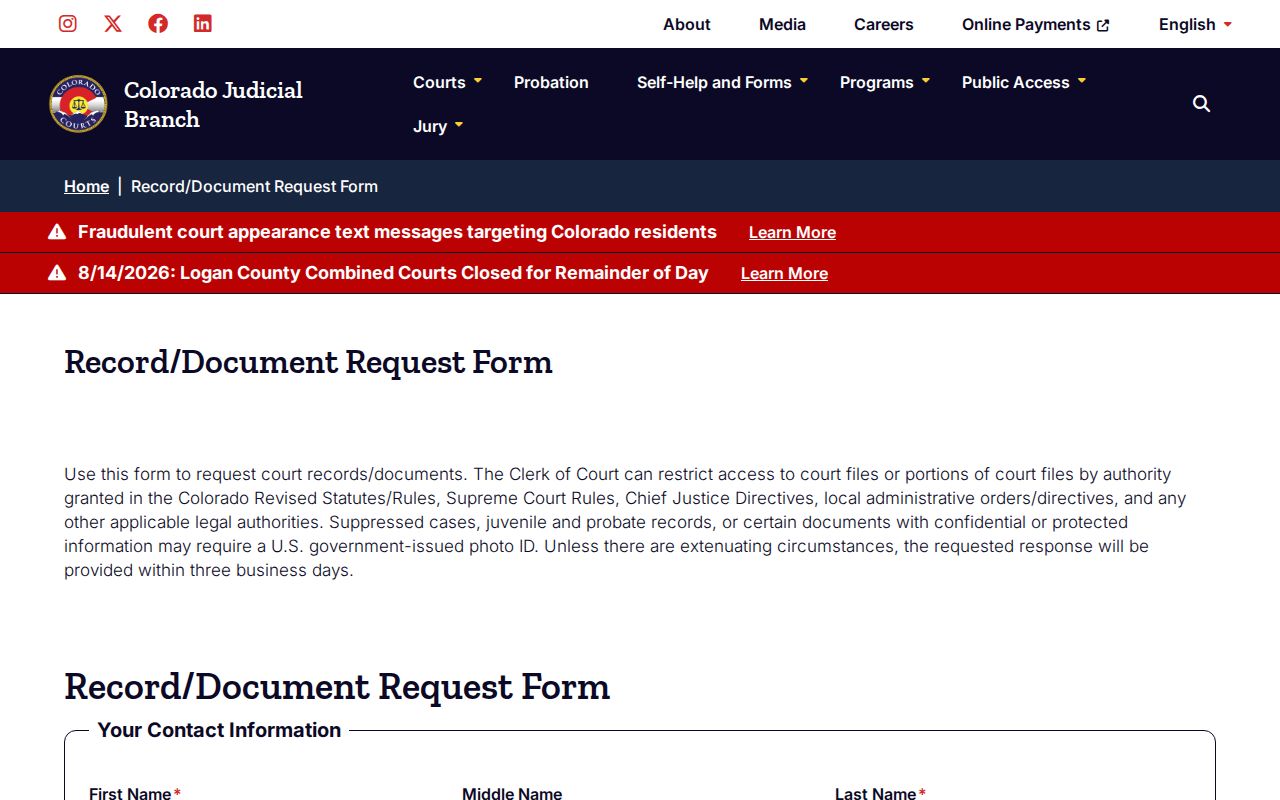
The form splits out family, criminal, civil, probate, ROA, and certification choices. That helps the Combined Court clerk route each Cheyenne County request.
Every offline route works too. Walk into the courthouse at 51 S. 1st St. in Cheyenne Wells, CO 80810 during confirmed counter hours. The phone number is 719-767-5649. Email goes to colleen.palmer@judicial.state.co.us, and mail reaches the court at Cheyenne County Combined Court, P.O. Box 696, Cheyenne Wells, CO 80810. The current location page lists a fax of 719-931-0022. Confirm fax is accepted before sending payment data or anything protected. No public terminal is published, so ask the clerk whether an on-site workstation exists.
- Identify whether Cheyenne County Court or Cheyenne County District Court holds the case.
- Locate the case number through the docket or provide names, year, and case class.
- Choose the ROA, exact filing, transcript route, or certification that fits the need.
- Select Cheyenne County and provide complete contact and mailing details.
- Wait for the Cheyenne County clerk's fee quote and payment directions before sending funds.
Three Cheyenne County Record Products
Three products answer three different questions. The register of actions is the docket index. It lists dates, event labels, charges, sentence or minute-order summaries, settings, and disposition. The filed document is the real item. That is the complaint, motion, order, judgment, ticket, or will itself. A certified or exemplified copy carries the clerk's authentication for a formal purpose.
One caution about third parties. A paid commercial ROA is not the official Cheyenne County record. Approved vendors do not hand over the filed images. Use the ROA to learn the title and date of the paper you need. Then ask the Combined Court clerk for that exact item. If certification matters, say so up front. The fee and the clerk's process both differ from a plain copy.
| Record Product | What It Provides | Where to Get It |
|---|---|---|
| Register of actions | Chronological index and case activity | Approved vendor or official clerk request |
| Filed document | The actual complaint, order, ticket, judgment, or other filing | Cheyenne County Combined Court |
| Certified or exemplified copy | Clerk-authenticated document | Cheyenne County Combined Court |
Cheyenne County Court Records Clerk
Colleen "Coky" Palmer is listed as Clerk of Court, Probate Registrar, and Jury Commissioner all at once. That combined role counts. One office can tell you whether a Cheyenne County record sits in County Court or District Court, and whether a probate request needs extra access review.
District judges rotate through the four-county 15th Judicial District. The local clerk stays put. When an online docket result confuses you, the clerk can name the right court, pull up an ROA, and quote the correct copy or certification charge.
Kinds of Court Records
One unified clerk serves the two Cheyenne County state trial courts. District Court holds the felony, major civil, domestic-relations, juvenile, probate, and mental-health dockets. County Court takes misdemeanor, traffic, small-claims, protection-order, and limited civil cases. The clerk doubles as probate registrar. Municipal ordinance matters filed by Cheyenne Wells or Kit Carson stay with the town that filed them.
The statewide form mirrors those case families. Criminal options run from a complaint or information to a disposition or sentence order, protection order, ticket, and ROA. Civil options include an order for judgment, a transcript of judgment, a satisfaction of judgment, a protection order, and the ROA. Family and probate groups carry their own decrees, plans, agreements, letters, wills, trusts, petitions, and related papers.
- District criminal and major civil case files
- County misdemeanor, traffic, small-claims, and limited civil files
- Domestic-relations, probate, juvenile, and protection-order records where accessible
- Judgments, satisfactions, tickets, minute orders, and other filed papers
- Registers of actions, certified copies, and hearing transcripts through their proper routes
Cheyenne County Request Form Fields
The form opens with requester identity and contact details. A mailing address, state, city, and ZIP code are required. Case number is optional; the official example given is 2019T999999. Case type, filing year, county, and other identifiers help the clerk find the right Cheyenne County file. Party information must be filled in. Date of birth stays optional, so use it only when it truly matters.
Document groups then narrow the order. You can pick named family, criminal, civil, or probate papers, an ROA, another specified record, and certification or exemplification. Be aware that suppressed, juvenile, probate, or protected files may demand government-issued photo identification. Submitting the form does not override any legal restriction.
| Field Group | Key Inputs | Why It Matters |
|---|---|---|
| Requester | Name, email, phone, mailing address | Supports clerk follow-up and delivery |
| Case locator | Number, type, year, Cheyenne County | Routes the request to the correct state court file |
| Party details | Names and optional added identifiers | Helps when the case number is unknown |
| Document choice | Named filing, ROA, or other description | Avoids an overbroad file request |
| Authentication | Certified or exemplified selection | Tells the clerk a formal copy is needed |
Court Records: What They Contain
Every case starts with a header. It carries the number, class, court, division, filing date, status, and caption. From there the ROA indexes parties and counsel, filings, minute orders, settings, continuances, disposition, and any financial entries that are public and recorded. A full file adds the papers underneath. Read the index first, and your document order gets much more precise.
Context matters when you read a docket. A motion entry proves a request was filed, not that the judge granted it. A judgment entry may leave out full terms. A transcript of judgment is a certified judgment record for authorized enforcement or recording, while a hearing transcript is the typed account of a proceeding. The two follow different request paths.
| Case header | Year, case class, sequence, court, division, status, and filing date |
|---|---|
| Parties and counsel | Names, legal roles, and attorney appearances where public |
| Chronology | Filings, minute orders, hearings, notices, resets, and rulings |
| Outcome | Disposition, judgment, sentence, dismissal, or satisfaction entries |
| Underlying papers | Documents requested separately from the clerk |
Older Cheyenne County Court Records
Older Cheyenne County court files are not all online. The state never promised that digitization reached every docket book or transferred case. No official page claims it did. So call the Combined Court clerk and ask a direct question. Is the file still active, stored off-site, or already at the Colorado State Archives?
Off-site retrieval bills at actual cost. Get an estimate first. Treat the archives as a last resort. Use it only after the Cheyenne County clerk confirms the court no longer holds what you need.
Cheyenne County Hearing Transcripts
A hearing transcript is not just another checkbox on a document request. It takes JDF 4. You file it with the Cheyenne County clerk by mail, delivery, or email under 15th Judicial District instructions. The clerk then assigns the work to a transcriber or court reporter. That person quotes an estimate. Work starts after the deposit. The finished transcript is released once final payment clears.
Under CJD 05-03, Colorado's local instructions offer no audio CD or tape as a substitute. Describe the hearing carefully: date, court, case number, and the portion you need. Long proceedings cost more and run longer. Ask the assigned transcriber about price and timing. Do not assume the standard document-form response window covers transcript delivery.
Note: A transcript of judgment is a court record with a published fee. A hearing transcript requires JDF 4 and a separate estimate.
Copy Fees and Certification
Cheyenne County record charges follow the statewide schedule on the request form. That schedule comes from Chief Justice Directive 06-01. Plain copies run $0.25 per page. Parties and their lawyers face a $15 maximum copy charge for their case. Nonparties have no cap. Certification or exemplification is listed at $20 per document, on top of any copy pages. A name search costs $5.
The official CJD 06-01 fee directive page sets out the statewide fee schedule itself.
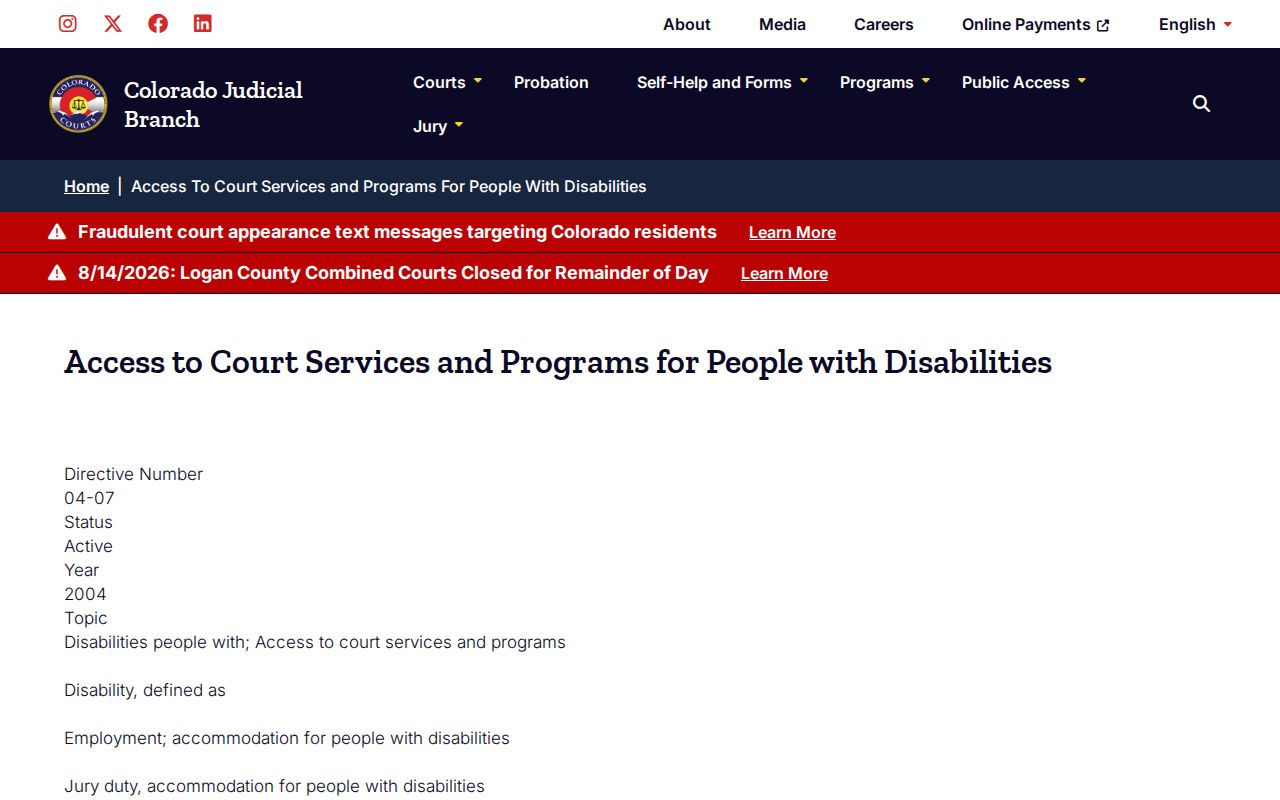
The directive is the statewide authority behind Cheyenne County copy, search, and certification charges. It also covers required waivers where they apply.
| Item | Published Amount | Notes |
|---|---|---|
| Plain copy | $0.25 per page | Party or lawyer maximum is $15 for that case; no nonparty maximum |
| Certified or exemplified copy | $20 per document | Applicable page charges may be added |
| Name search | $5 | Useful when the case number is unknown |
| Transcript of judgment | $25 | Not the same as a hearing transcript |
| Certificate of satisfaction | $20 | Statewide request-form estimate |
| Research or redaction | $30 per hour | Quarter-hour increments after the first hour |
| Off-site retrieval | Actual cost | Ask for an estimate |
Cheyenne County Record Timing
The online request form gives a working benchmark. The selected court normally responds within three business days, absent extenuating circumstances. That clock measures the first contact, not delivery. No rule promises every Cheyenne County record lands in your hands in three days.
Off-site files, heavy redaction, certification, and hearing transcripts can all stretch the timeline. Quote first, then order a large file. The local page does not itemize payment methods. Get instructions from the clerk and never mail cash. For historic material, ask one question. Does the Combined Court still hold it, or did it move to the Colorado State Archives? The archives backs up transferred records; it does not replace the county clerk.
When a commercial search misses something, start with a Cheyenne County docket search. It pinpoints the case. Then place a focused document order.
Cheyenne County Federal Court Records
Federal cases never land in the Cheyenne County Combined Court file. A federal civil or criminal case from the county belongs to the U.S. District Court for the District of Colorado. Bankruptcy goes to the U.S. Bankruptcy Court for the District of Colorado. Public electronic access runs through PACER.
Read the court name on the filing before you order. State and federal systems can carry similar case terms. Yet their custodians, case numbers, portals, and charges stay entirely separate.
Access Rules for Court Records
Chief Justice Directive 05-01 joins Colorado Supreme Court public-access rules in governing judicial case records. Criminal-justice records fall under the Colorado Criminal Justice Records Act. The Colorado Open Records Act generally covers public records outside the distinct court-file framework, and the Children's Code adds further limits on juvenile access.
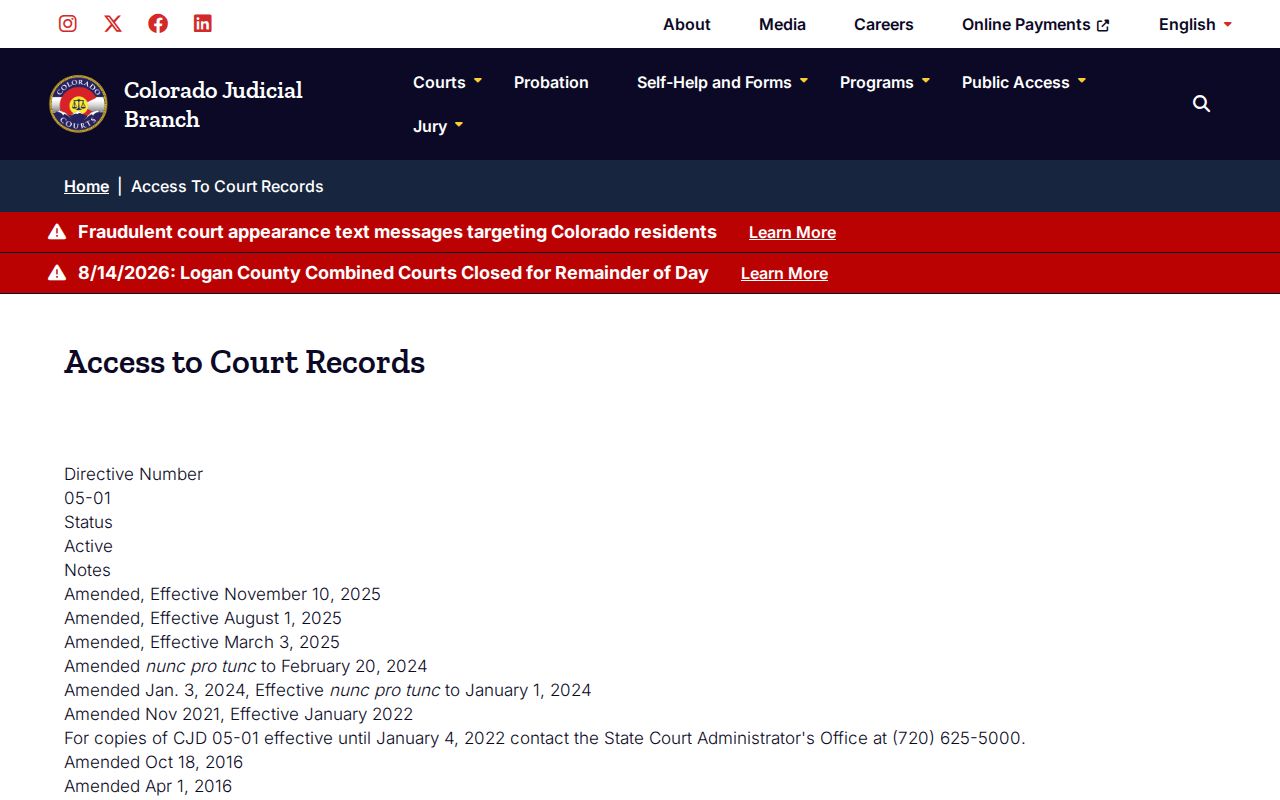
The directive page lays out the access framework the Cheyenne County clerk applies when reviewing a request to inspect, copy, redact, or restrict. The Judicial Branch public-record access guide also draws the line between vendor data and official court documents.
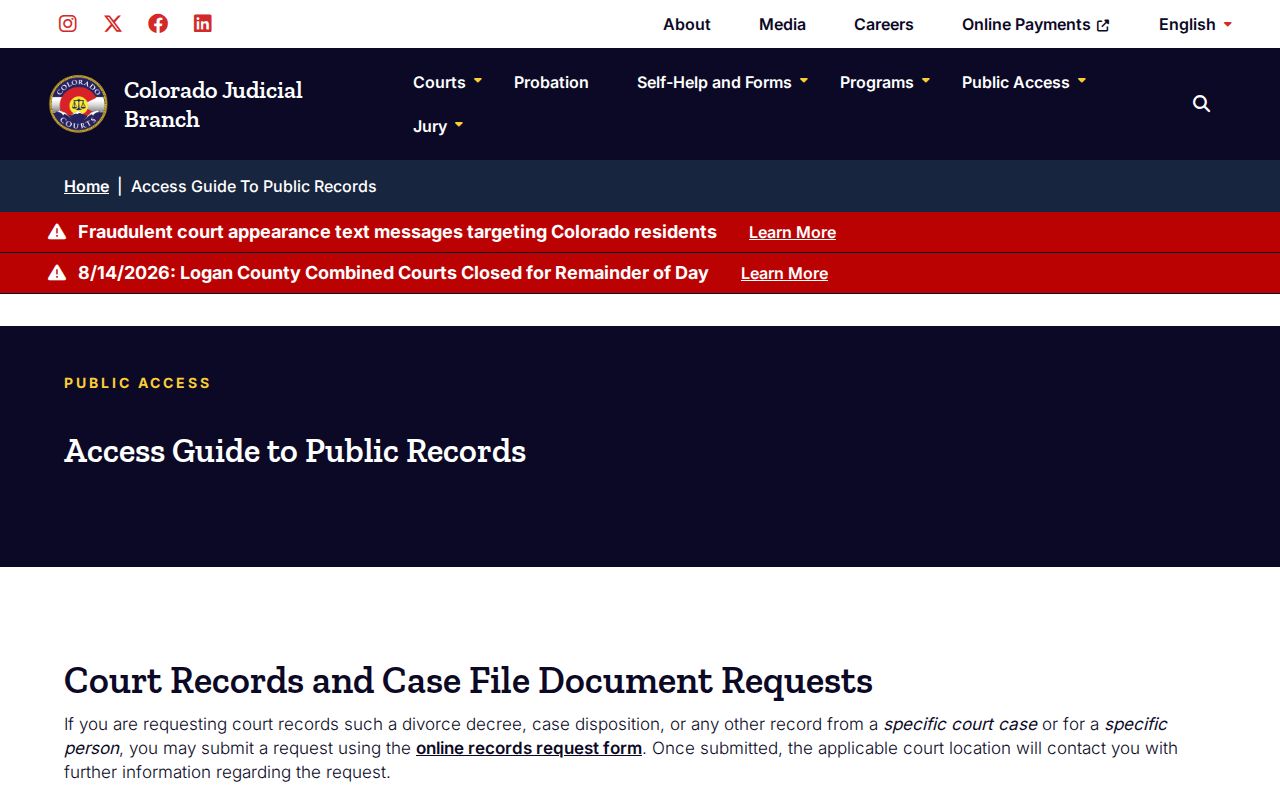
The access guide is blunt on one point. Approved online ROA vendors do not supply filed-document copies, and their data is not the official Cheyenne County record.
Public does not mean unrestricted: Sealed records, protected identifiers, judicial work product, court-reporter notes, and many juvenile or protected matters remain outside ordinary access.
Cheyenne County Combined Court
51 S. 1st St.
Cheyenne Wells, CO 80810
719-767-5649
Clerk of Court, District Court and County Court records, and probate registrar functions.
A sealing order binds clerk staff. They cannot set it aside on request; doing so may take a motion, petition, court order, or other lawful authority. And an empty docket search proves nothing about dismissal or whether a matter was ever filed.
Cheyenne County Record Identity Checks
Suppressed, juvenile, probate, and protected Cheyenne County records can require government-issued photo identification. The ID lets the clerk weigh your role as a requester. It does not unlock a restricted document. Nor does it cancel a sealing order.
Ask what proof is required before you travel or mail anything. Use only the channel the clerk approves for sensitive material. Describe the public portion you want as narrowly as you can.